

When “Don’t Blind-Click” Isn’t Enough: A Practical Comparison of Rabby Wallet and Mainstream EVM Wallets for US DeFi Power Users
Imagine you’re on a deadline: you need to rebalance a cross-chain liquidity position, move collateral between Layer 2s, and claim an airdrop — all while a token’s price is swinging. In that exact moment, the worst thing is uncertainty about what a signed transaction will do to your balances. The familiar ritual — open MetaMask, approve, hope for the best — used to be the default. For power users who run strategies across chains and contracts, “hope” is not a security model. This article compares practical defenses and trade-offs among EVM wallets with a focus on Rabby Wallet’s approach to transaction simulation, approval management, and institutional integrations, so you can decide which tools reduce real operational risk for accounts you care about.
The comparison below treats wallets as operational systems: custody model, attack surface, verification affordances, and integration with institutional controls. I’ll explain the mechanisms Rabby uses to reduce “blind signing” and approval exposure, where those mechanisms exactly help (and where they don’t), and how to combine them with hardware and multi-sig practices to create defensible setups in a US regulatory and threat environment.
How Rabby changes the signing decision — mechanism first
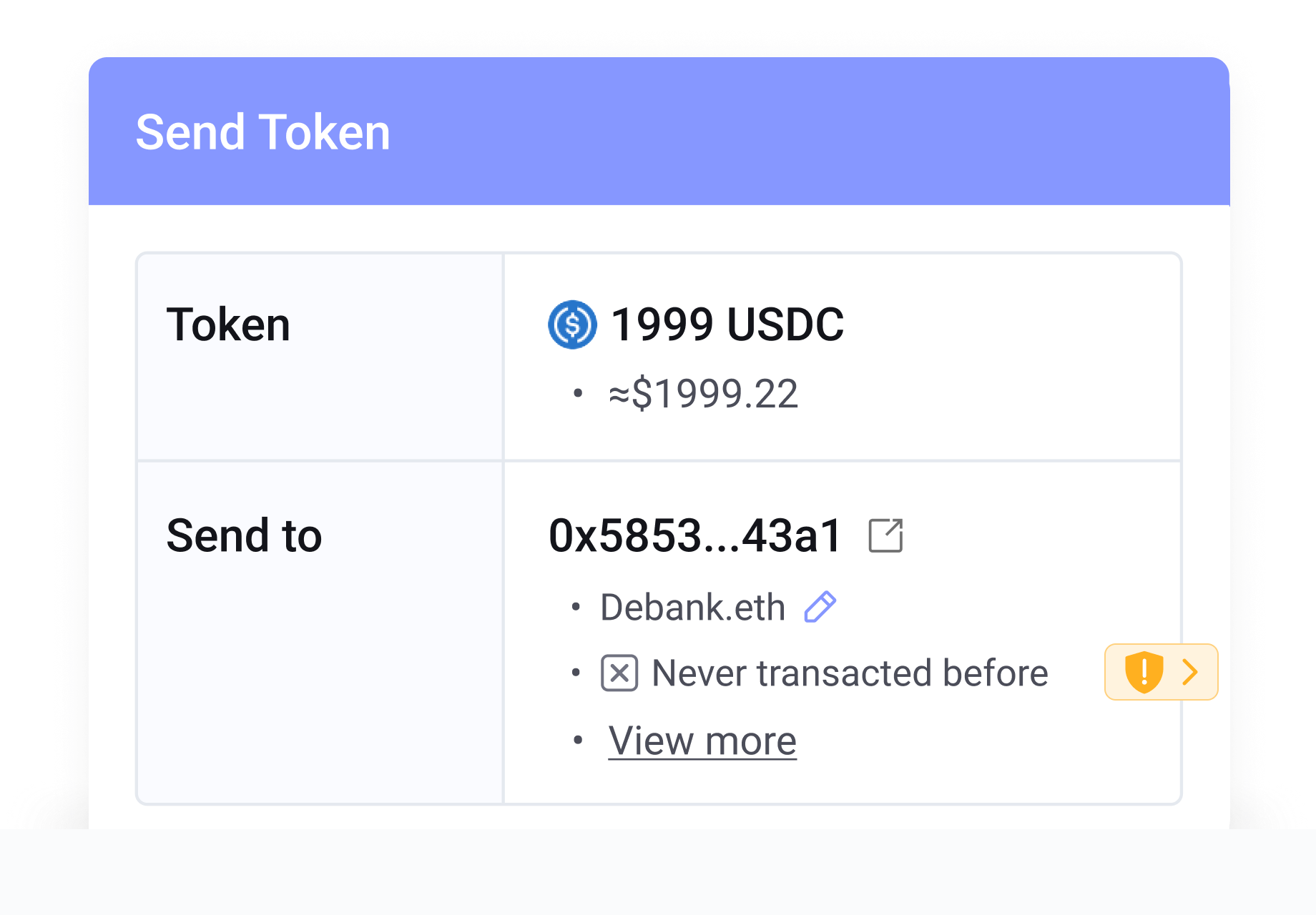
At its core, Rabby rejects the default posture of most wallets: “present the call data, trust the user to interpret it.” Instead Rabby runs a local transaction simulation pipeline that produces two concrete artifacts for each pending signature: an estimated pre/post token balance change and a set of risk flags that come from a security engine. Mechanistically this works by replaying the intended transaction against a node or local EVM simulator to compute state deltas (token transfers, approval changes, fee extraction). The security engine overlays heuristic and curated signals — whether a contract has a known exploit history, whether the approval amount is “infinite” and therefore dangerous, or whether the recipient address is unusual.
For a DeFi operator moving positions between chains, that means the wallet shows the expected tokens in and out and the gas cost before you hit “Confirm.” That seemingly small change shifts the user’s mental model from “I approve arbitrary calldata” to “I confirm the concrete economic effect.” This is not a panacea: it requires accurate simulation inputs (chain state, on-chain oracles, and correct nonce/gas assumptions). But in practice it reduces a common class of errors where users sign approvals or swaps without seeing slippage, sandwich loss potential, or approval exposure.
Side-by-side: Rabby versus MetaMask and Coinbase Wallet — trade-offs and best-fit scenarios
Here are practical distinctions that matter for people running DeFi strategies, presented as decision rules rather than marketing claims.
Transaction clarity: Rabby wins when you need explicit balance deltas before signing. MetaMask does not simulate autonomously; users often rely on the dApp UI, which can be manipulated. If your workflow involves interacting with unfamiliar contracts (token migrations, novel AMMs), Rabby’s simulation reduces ambiguity. But simulation is only as good as the state snapshot; on congested chains or with rare nonce/order dependencies, simulations can be misleading.
Approval surface control: Rabby’s built-in approval revocation tool gives a usable way to inspect and cancel active allowances without external explorers. For a trader who rotates tokens frequently or uses multiple DEX aggregators, this lowers persistent exposure. Alternatives require separate tooling or explorers. The trade-off: revoking approvals consumes gas and adds operational steps; it is a mitigant, not an elimination of risk (revocation itself has execution risk and can be front-run).
Institutional and hardware integration: Rabby integrates with Gnosis Safe and custody providers like Fireblocks, and supports many hardware wallets. For US-based teams that need multi-sig governance or custodial custody, that integration path is decisive. MetaMask has hardware and some enterprise tooling, but Rabby’s explicit multi-sig and enterprise connectors make it more plug-and-play for teams moving institutional flows from research to execution. The practical boundary condition: if your institution requires KYC-wrapped custody with particular compliance features, pure non-custodial tooling will still require additional orchestration.
Automatic network switching and cross-chain work: Rabby detects dApp networks and auto-switches, and includes a cross-chain gas top-up to solve a common operational snag: a new chain with zero native gas. That convenience reduces the chance of failed transactions and lost MEV exposure from failed submits. But auto-switching can be a surprise if you operate many accounts concurrently; it’s an ergonomic advantage with a small usability cost for advanced users who intentionally test on different networks.
Security history and honest limitations
Rabby’s open-source codebase and MIT license increase auditability; that is valuable but not sufficient. In 2022 a Rabby Swap contract exploit caused roughly $190,000 in losses. The response — freezing the contract, compensating users, and enhancing audits — shows a responsible incident response, but it also underlines a structural truth: wallets are an ecosystem, and third-party smart contracts they interact with remain an independent risk vector. The wallet can surface warnings, but it cannot fix buggy or malicious contracts.
Two operational limitations matter in practice for US users and traders: Rabby does not include an in-wallet fiat on-ramp, and there is no native staking dashboard that lets you stake tokens with one click. For teams that want a single app to buy, custody, stake, and trade, this matters. Practically, those are integration gaps rather than security weaknesses; you will need to use external on-ramps and staking interfaces and combine them with Rabby’s approval controls.
Where Rabby helps most — and where to still be paranoid
Rabby materially reduces two specific operational risks: blind signing and long-lived approvals. For an active DeFi operator these are high-impact — stolen funds from a careless approve or signing a malicious batch call can wipe an account. The recommended operational pattern becomes: use Rabby’s simulation to validate balance deltas, keep approvals minimal, and revoke them regularly; pair your extension with a hardware wallet for signing sensitive moves; and place large pools of assets behind multi-sig or custodial controls for settlement-level security.
Remaining threats that require other controls: social engineering (phishing pages that mimic dApps), supply-chain compromises (malicious extension versions), and front-running/extraction on mempools. Rabby’s simulation won’t prevent a user from pasting a malicious contract address into an apparently normal dApp, nor will it stop a compromised OS from leaking a seed. Those are policy and environment problems — use hardware wallets, isolate high-value accounts on dedicated profiles or machines, and keep small hot wallets for day-to-day operations.
Decision heuristics — when to pick Rabby
Here are three heuristics that translate the above into usable rules:
1) If you sign complex DeFi transactions across multiple EVM chains and need precise pre/post balance visibility, choose Rabby for its transaction simulation. 2) If you manage funds for a small team or DAO and want tighter approval controls and multi-sig integrations, Rabby’s enterprise connectors and revocation tool reduce operational friction. 3) If your workflow requires an integrated fiat flow or native staking inside the wallet UI, expect to use Rabby alongside other providers because those features are not native.
For readers who want hands-on exploration, the wallet is available as an extension and desktop/mobile clients; you can read more about setup and features here: rabby wallet.
What to watch next — conditional signals and near-term implications
Watch for three developments that would materially change the calculus: broader integration of on-ramp partners inside Rabby (would reduce toolchain complexity), demonstrated improvements to simulation fidelity under high-congestion conditions (would reduce false negatives), and standardization of semantic transaction metadata across popular dApps (would let wallets offer even clearer human-readable descriptions of effects). If any of these arrive, the marginal value of simulation-first wallets will increase. Conversely, a sustained pattern of supply-chain attacks on extensions would shift risk budgets away from browser extensions toward hardware-only workflows.
FAQ
Does Rabby’s transaction simulation guarantee safety?
No. Simulation significantly reduces “blind signing” risk by showing estimated balance changes and fee costs, but it is not a formal guarantee. Simulations depend on accurate chain state, correct gas and nonce assumptions, and honest contract behavior. They also cannot prevent phishing pages or a compromised device from causing loss. Treat simulation as a strong detection tool, not an absolute safety net.
Can I use Rabby with hardware wallets and multi-sig?
Yes. Rabby supports Ledger, Trezor, Keystone, and several other hardware devices, and it integrates with multi-sig and enterprise solutions like Gnosis Safe and Fireblocks. For US institutional users, that means Rabby can sit at the interface layer while custody or signing policies remain with enterprise-grade providers.
How does approval revocation help, and when is it insufficient?
Revocation removes or reduces a contract’s approved allowance to move tokens, cutting exposure if a contract is later exploited. It is effective against long-lived approvals but requires on-chain transactions (gas, potential front-running) and does not protect against exploits where funds are drained via approved transfer just before revocation. Use revocation alongside best practices: minimal approvals, frequent audits of active allowances, and segregated cold storage for large holdings.
Is Rabby better than MetaMask for everyday users?
For casual, small-value users the difference is incremental. For power users managing cross-chain positions, interacting with unknown contracts, or running team accounts, Rabby’s features (simulation, revocation, auto network switching, and institutional connectors) provide material operational risk reduction. The best choice depends on your threat model and whether you can operationalize the extra steps (revocation, hardware integrations) that stronger setups require.
Please contact for more information:
 Lawyer: Nguyen Thanh Ha (Mr.)
Mobile: 0906 17 17 18
Email: ha.nguyen@sblaw.vn
Lawyer: Nguyen Thanh Ha (Mr.)
Mobile: 0906 17 17 18
Email: ha.nguyen@sblaw.vn